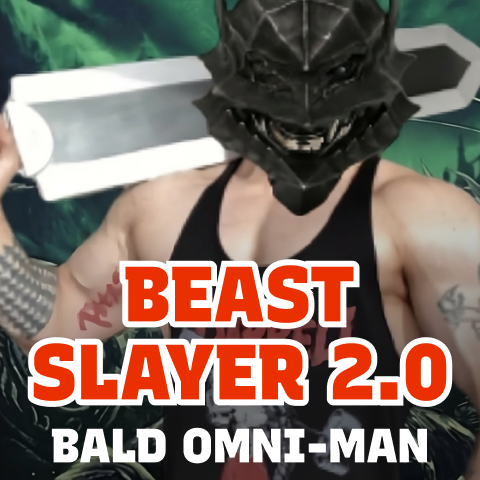
Beast Slayer: Berserk Method Full Body Program 2.0
Ultimate Full Body Program for BRUTAL Size & Strength. Updated 2025 version!
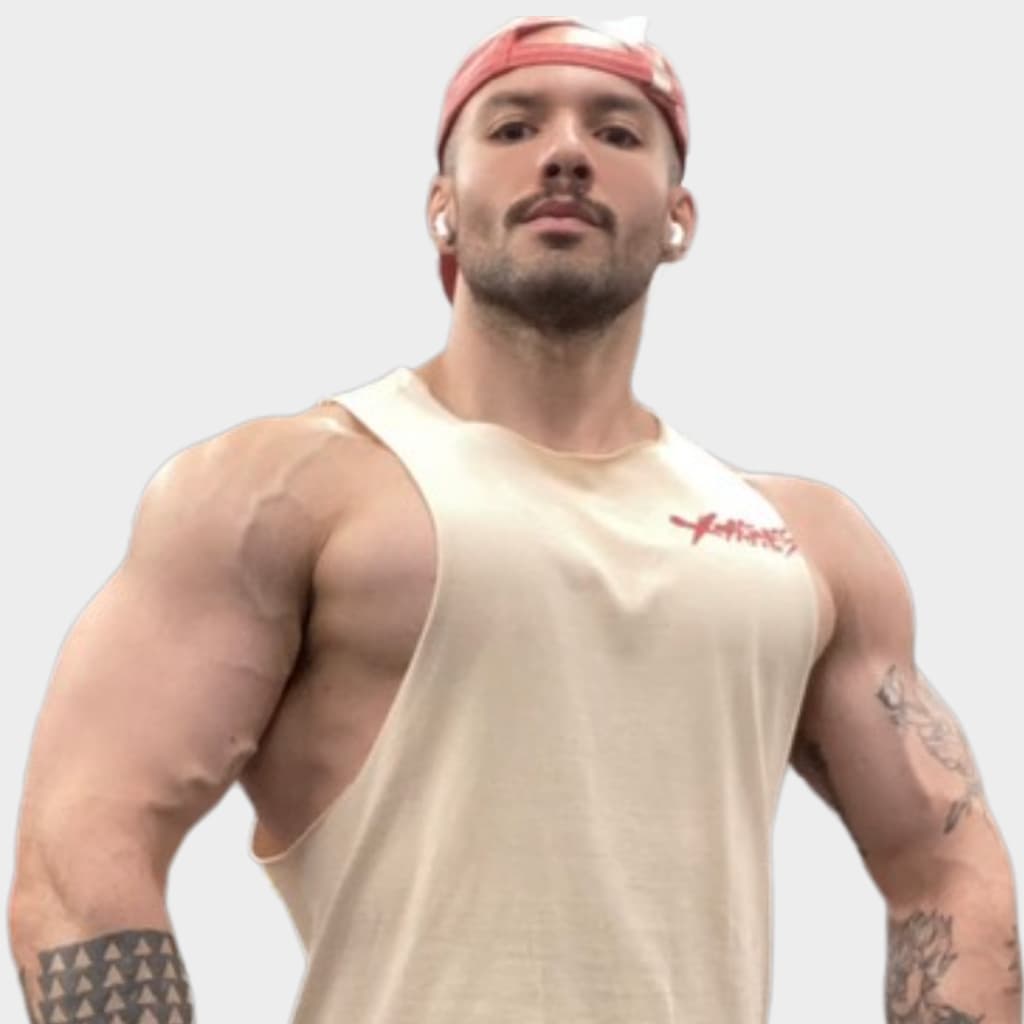
Coach Paris Butler. YouTuber (70K+ Subs)
Overview
Welcome to the 2025 edition of Beast Slayer. You will enjoy the key aspects of the original release alongside quality of life changes, better programming structure, new exercises, and most importantly changes that reflect common pieces of feedback. (I included more pulling volume, for instance). Beast Slayer offers a 3x Upper Body, 2x Lower Body Frequency with 4 Training Days. We acheive this through combining upper lower and full body, but in a way that is approachable and sustainable. Please enjoy.
For the full doc and spreadsheet of the program, go here:
https://docs.google.com/spreadsheets/d/1T8UxbsBU4Zi9AuuEcWhuR6iIO6K17xReoHCa09zJHjM/edit?usp=drivesdk
For my personalized programming & nutrition guidance app, go here:
https://coachos.superwall.app/omni
Tip 1:
Have a stopwatch on your phone. Set it for 60-90 minutes depending on what I outline for the day, after you’re done warming up, BOOM. Start the clock. Time efficiency is a big deal, so I calculated the session times based on how long it took me to complete each session, so your training time should be equal to or slightly less than me.
Having that stopwatch helped me shave off anywhere between 30-40 minutes off my time spent in the gym! You don’t realize how much extra time you spend dilly dallying on your phone, which can lead to you resting longer than you intend to. More rest isn’t always a good thing either, because sometimes you can actually get a bit less prepared if the rest is too excessive.
Tip 2:
Gym bag essentials are:
Liquid Chalk
Versa Gripps or Lifting Straps
Lifting Belt
Intra Workout nutrition (fast digesting carbs are king)
A log book
Some water or a sports drink
Frequently Asked Questions/Comments:
Q1: What is a Double Progression/Dynamic Double Progression? How do I do it properly?
Double Progression and Dynamic Double Progression
Double Progression and Dynamic Double Progression are easy ways to map out progression and auto-regulate your training. (Auto-regulate meaning: make training appropriately challenging)
I like using this in a hypertrophy program, because unlike traditional strength training, we don’t have percentages to work with. Particularly for things like Calf Raises, Hamstring Curls, Hack Squats, and all traditional bodybuilding staples.
Double Progression
In basic Double Progression, you’re given a set and rep range.
For example, 3 sets of 8-12. Each week, you add reps until you’re at 3x12, then you add weight and do it all over again.
This type of progression undulates between volume and intensity, allowing you to typically train harder without a deload.
There are two ways to start off a double progression. You can do 3 sets of 8 (leaving a couple reps in the tank on your first set) and then each week, add reps until you get to 3x12. You can add reps to each set, or reps to one set at a time.
OR If you’re newer, you can do 12 reps on your first set (leaving a couple reps in the tank) and then fill out your reps on subsequent sets each week.
(This second approach is typically the approach I take for new exercises that I’m not sure of my performance on) I also recommend this for people who tend to UNDERSHOOT (go too easy)
When you add weight, add enough weight so that 8-9 reps would be challenging again (tl,dr; add like 5-10 lbs)
Then you follow the same progression scheme for the new weight you’ve selected
Dynamic Double Progression
Dynamic Double Progression is basically the same thing, except that each individual set progresses in weight on its own once you reach the top end of your rep range. For example, using 8-12 again:
Week 1: 3x8 @ 200
Week 2: 1x12 @ 200 (increase this set’s weight next week) 1x10 @200, 1x9 @ 200
Week 3: 1x8 @ 210, 1x12@ 200 (increase this set’s weight next time), 1x10 @200
So on, and so forth. This type of progression is better for heavier compound lifts in my opinion.
General Reminders:
The way that I like to coach double progression and dynamic double progression is like this:
That first week you try a new exercise, each set, other maybe than the last couple, should be a couple reps shy of failure. This lets you create momentum with your training. As opposed to if you go to failure on everything week 1, you’ll have a harder time (or an impossible time) progressing.
For subsequent weeks, more and more of your sets can be (and should be, in my opinion), close to, or at failure.
If you undershoot that first week, the way double progressions work, you’ll be using a challenging weight anyway with time.
Triple Progression:
Triple Progression is exactly the same as a double progression, the only difference is that you progress using an improvement of rep quality as a metric as well.
For example, if you max out a rep range at 3x12, but there are more than a few reps that are sloppy, you can progress next week by making more of the reps higher quality. Recording your reps helps a lot with this.
Q2: When to Swap Movements
I say that we should keep our motions in rotation for as long as possible. It’s very easy to fall into the trap of constantly swapping exercises, and never make any real progress.
But if we keep our motions in for long enough to outlast noobie neurological adaptations, we can ensure that any progress that we make comes from actual hypertrophy, and not just neurological strength adaptations.
When you DO swap a movement, pick a variation that works the same muscles as the one that you were just doing, so the thread of progression can remain.
It’s important to take note of which variations work the best for us as well, so that you can swap back to them when the time comes.
Q3. Can I Add More Volume? Is this enough volume to grow?
This is a question that many lifters will have. Maybe you’re accustomed to doing more/less volume – this is why you’re given a range on Beast Slayer. As a rule of thumb: if you’re adding reps and weight, you’re doing enough volume to grow. If you’re not making progress, audit yourself FIRST:
Am I eating enough? (have I gained weight the past few months?)
Am I sleeping enough?
Am I drinking enough water?
Am I ensuring that I eat before training?
Am I properly following the progressions outlined (it is SUPER common for this to be the issue. Thoroughly read the section on double progressions if you’re not familiar)
Is my effort in the gym adequate in general?
Finally, is this variation just stale? (I have made progress with it for 6-8 weeks already)
Q4. How do I track weighted calisthenics?
Combine your body weight with the weight that you add to your belt. The reason to track it this way, as opposed to just the weight added, is simple: your body weight, and thus the total weight you lift, will fluctuate. There is a HUGE difference between a 160 lb guy doing weighted calisthenics, and a 220 lb guy doing them, and this has to be accounted for.
Q5. What kind of form should I strive for?
I go by the rule of using common sense when it comes to technique. I would use a controlled (but not overly slow) eccentric, and a pause when applicable.
That being said, do not get pedantic - just maintain +/- 10% of your rep quality at all times. Too much control leads to inferior stimulus typically (especially if you can’t use a lot of weight).Conversely, too little control leads to the muscles not being stimulated well.
tldr, control the weight but don’t be a tryhard.
Q6. How and When To Deload?
I want you to deload when you feel that you need to. The program is designed in such a way, that the volume and intensity ebbs and flows automatically, but at some point, you will need an actual deload.
I recommend deloading ONLY the sessions that feel janky, and to reduce the loads by about 10% and do less sets. It won’t be very often that you need to make every session a deload or have a full deload week, but if you need to deload multiple sessions, this is fine as well.
Q7. How to Run Linear Periodization?
I’m a big fan of linear progression based on a percentage of your 1 rep max, combined with RPE for your main exercises. (Bench, Deadlift, Squat, whatever you want to train for strength, along with their variations
I generally say, start around 60-70%, and do 3-5 sets, repping each set to about RPE 6-8 on average (no set until your max out should be to failure). Each week, increase your working weight by 2-4%. When the weights get to 80% or more, we include top singles once a week to practice heavy singles.
Any movement labeled with LP is meant to be a key performance metric, intentionally increase your performance on these.
Here is how that generally looks, and what I have done exactly with great success (assuming you do 3 sets for your movement):
Week 1: 3 Sets @ 63%, rep each set to RPE 7
Week 2: 3 Sets @ 67% rep each set to RPE 7
Week 3: 3 Sets @ 71% rep each set to RPE 7
Week 4: 3 Sets @ 75% rep each set to RPE 7
Week 5: 1 Set @ 83% repped to RPE 9, 2 sets @ 73% rep to RPE 8
Week 6: 1 Set @ 86% repped to RPE 9, 2 sets @ 76% rep to RPE 8
Week 7: 1 Set @ 89% repped to RPE 9, 2 sets @ 79% rep to RPE 8
Week 8: 1 x1 @ 92%, 2 sets @ 82% rep to RPE 9
Week 9: 1 x1 @ 95%, 2 sets @ 85% rep to RPE 9
Week 10: 1 x1 @ 100-101% (either aim to equal your PR and make it look easy, or go for a 5 lb PR) 2 sets @ 85% rep to RPE 9
Q9. What are Ascending Sets?
Ascending Sets refer to working up to a heavy set starting from a lighter weight. If you’re prescribed ascending sets of 12, you’ll do 12 reps starting with the bar, then 95, 135, 185 etc until you hit your last set.
I love ascending sets as a light or medium day pump workout, particularly with dumbbells or anything I can get a big stretch with. I use ascending days so that I’m not just going heavy each day. This is done in order to promote recovery and fun gym sessions.
Here’s an example of how ascending sets typically go:
Set 1: bar for prescribed reps
Set 2: 95 lbs for prescribed reps
Set 3: 135 for prescribed reps
Set 4: 185 for prescribed reps
Set 5: 225 for prescribed reps
Set 6: 245 for prescribed reps
Set 7: 265 for prescribed reps
As you can see, you get a lot of blood flow via the light volume at the start, and the sets ramp up in difficulty very quickly as you go on from there. This type of workout is a great way to get more out of less weight.
Use your common sense with the weight jumps!
Q10. What are Cluster Sets?
Cluster sets are a fun way of getting in mass volume on an exercise in a short amount of time, and I prefer it for lighter scale movements where a little form breakdown won’t snap you up. Don’t PURPOSELY use dog shit form, but don’t be johnny biomechanics if it means sacrificing 2-3 reps.
Find a cool song that’s 3-5 minutes long, and do clusters of 3-5 reps with 5-10 seconds rest in between clusters, and repeat until the song is done.
Who it's for
Reviews
I was already following the Berserk Method ideas for a 5-day split but had a need to drop to 4 days. This was a seamless transition that removed my need to worry about programming and let me focus on executing.
This program is good for cutting. Not too much volume and allows good amount of recovery. I play basketball 3 times a week and I still enjoy the program with all the condition I do.
Great program! Been doing the lower, upper, and arm days pretty much as-is. The only place I've made significant changes is the full body day. It didn't serve my athletic goals, so I swapped out some of the prescribed exercises for Olympic lifts and plyometrics. Still 5 stars out of 5 though!
I love this program, enough room to add all the quirks I love about working out, dedicated 5th ab day just for my enjoyment. legs growing, coming back to this after having to switch gyms / a bunch of different locations due to military orders. Came back and overwhelmed with how much I missed hitting this program 😭 I was confused why I wasn’t getting the same pumps for a while. cluster sets OP
Muscle engagement
| # | Exercise | Sets | Reps |
|---|---|---|---|
| 1 | Lying Leg Curl | 2 | 6–12 reps |
| 2 | High Bar Squat (Barbell) | 2 | 6–10 reps |
| 3 | Standing Calf Raise | 3 | 10–15 reps |
| 4 | Single Leg Romanian Deadlift | 2 | 6–10 reps |
| 5 | Hip Adductor (Machine) | 2 | 8–12 reps |
| 6 | Hanging Leg Raise | 2 | 10–20 reps |
| 7 | Single Leg Press | 2 | 8–12 reps |
| # | Exercise | Sets | Reps |
|---|---|---|---|
| 1 | Bench Press (Wide Grip) | 2 | 5–10 reps |
| 2 | Lat Pulldown | 2 | 5–10 reps |
| 3 | Bench Press (Dumbbell) | 2 | 8–12 reps |
| 4 | Chest Supported Row (Dumbbell) | 2 | 8–12 reps |
| Superset | |||
| 5A | Tricep Pushdown (Cable) | 2 | 8–12 reps |
| 5B | Bicep Curl (Dumbbell) | 2 | 8–12 reps |
| 6 | Tricep Extension (Dumbbell) | 2 | 8–12 reps |
| 7 | Lateral Raise (Dumbbell) | 2 | 10–15 reps |
| # | Exercise | Sets | Reps |
|---|---|---|---|
| 1 | Squat (Paused) | 3 | 5–10 reps |
| 2 | Calf Raise (Machine) | 3 | 8–12 reps |
| 3 | Seated AD Press | 3 | 5–10 reps |
| 4 | Pullover (Dumbbell) | 2 | 8–12 reps |
| 5 | Seated Hamstring Curl | 2 | 8–12 reps |
| Superset | |||
| 6A | Seated French Press | 2 | 10–15 reps |
| 6B | Incline Curl (Dumbbell) | 2 | 8–12 reps |
| # | Exercise | Sets | Reps |
|---|---|---|---|
| 1 | Dip (Weighted) | 2 | 8–12 reps |
| 2 | Chin-Up (Weighted) | 2 | 8–12 reps |
| 3 | Leg Raise | 2 | 10–20 reps |
| Superset | |||
| 4A | V-Handle Tricep Pushdown (Cable) | 2 | 8–12 reps |
| 4B | Incline Curl (Dumbbell) | 2 | 8–12 reps |
| 5 | Overhead Tricep Extension (Cable) | 2 | 6–10 reps |
| 6 | Chest Supported Row (Machine) | 2 | 10–15 reps |
| 7 | Lateral Raise (Cable) | 2 | 10–15 reps |
Weeks 2–12 are in the app
Download Boostcamp to follow the full program with auto-progression and built-in coaching notes.
The coach
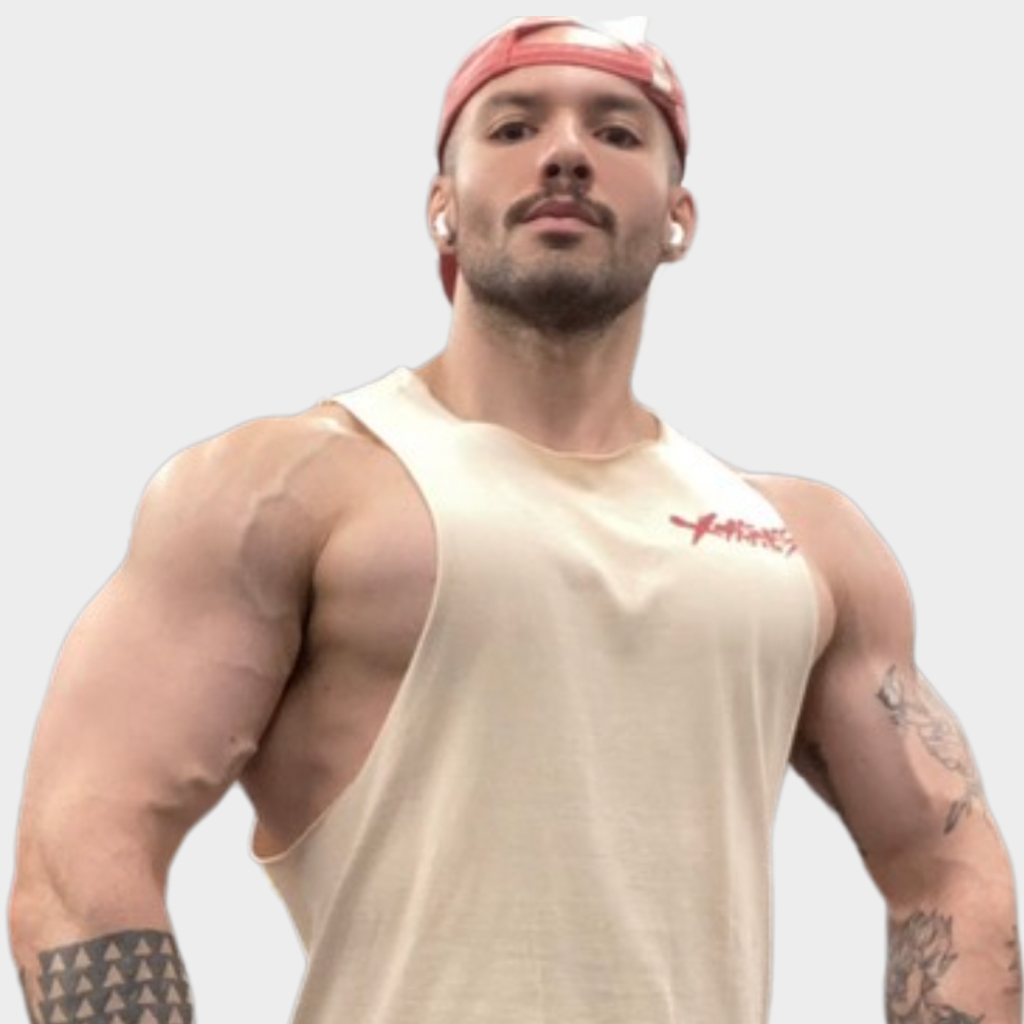

Hey guys! My name is Coach Butler, not Bald Omni-Man. My YouTube channel is all about showing you how to lift. This channel is meant to be my personal training log, and a resource for anyone that wants to learn how to train for long term success!
I’m a big fan of anime, manga, video games, and western works of art as well. It would be hard for you to name something I haven’t watched or read! Disclaimer: Bald Omni-Man is not a medical professional or a doctor. Always consult a medical professional before starting any exercise program. Use of this information is strictly at your own risk. Bald Omni-Man will not assume any liability for direct or indirect losses or damages that may result from the use of information contained in this video, including, but not limited to economic loss, injury, illness, or death.
How Beast Slayer: Berserk Method Full Body Program 2.0 works
Beast Slayer: Berserk Method Full Body Program 2.0 is a standard-length, 12-week, 4-day-per-week hypertrophy program written for beginner lifters. Each session takes around 75 minutes to complete. It was created by Bald Omni-Man and is published on Boostcamp with full week-by-week structure built in.
The program runs as a 12-week block with the same training-day structure throughout. It's built around a full gym setup. Inside the Boostcamp app, working weights and targets auto-progress between sessions based on what you actually lifted, so you don't manage the math by hand.
Beast Slayer: Berserk Method Full Body Program 2.0 is appropriate for new and returning lifters. The session-by-session structure removes the guesswork that usually stalls beginners. Over 1,397 Boostcamp athletes have run it. It's fully free on Boostcamp. Every week is unlocked from day one on iOS and Android.
Common questions
Yes, Beast Slayer: Berserk Method Full Body Program 2.0 is completely free to follow on Boostcamp. There's no subscription or payment required. Download the app on iOS or Android, search for the program, and you can start your first workout immediately. All 12 weeks are fully unlocked.
This program is built around a full gym. Make sure you have consistent access before starting, since the progression model assumes you can perform the same movements week over week. If you're missing something, the Boostcamp app includes substitution suggestions inside each workout.
Each session typically takes around 75 minutes to complete. That estimate covers your working sets but doesn't account for warm-up or rest between sets, so budget a little extra time when you're first learning the movements. As you get familiar with the program, sessions tend to move faster.
Beast Slayer: Berserk Method Full Body Program 2.0 is structured around 4 training days per week, with rest days built in to allow for recovery. Consistent rest is as important as the training itself. Skipping rest days can stall your progress. The app lets you reschedule sessions if your week doesn't go to plan.
The program runs for 12 weeks. The structure is designed so that each week builds on the last, with weights, volume, or intensity progressively increasing as you go. Many athletes choose to repeat the program after finishing, either at a higher starting weight or with a different variation.
Beast Slayer: Berserk Method Full Body Program 2.0 is available inside the Boostcamp app, free on iOS and Android. Once you download the app, you can search for the program by name or find it on the coach's profile. The app tracks all your sets and weights automatically, so you always know exactly what to do next session.
Get started